
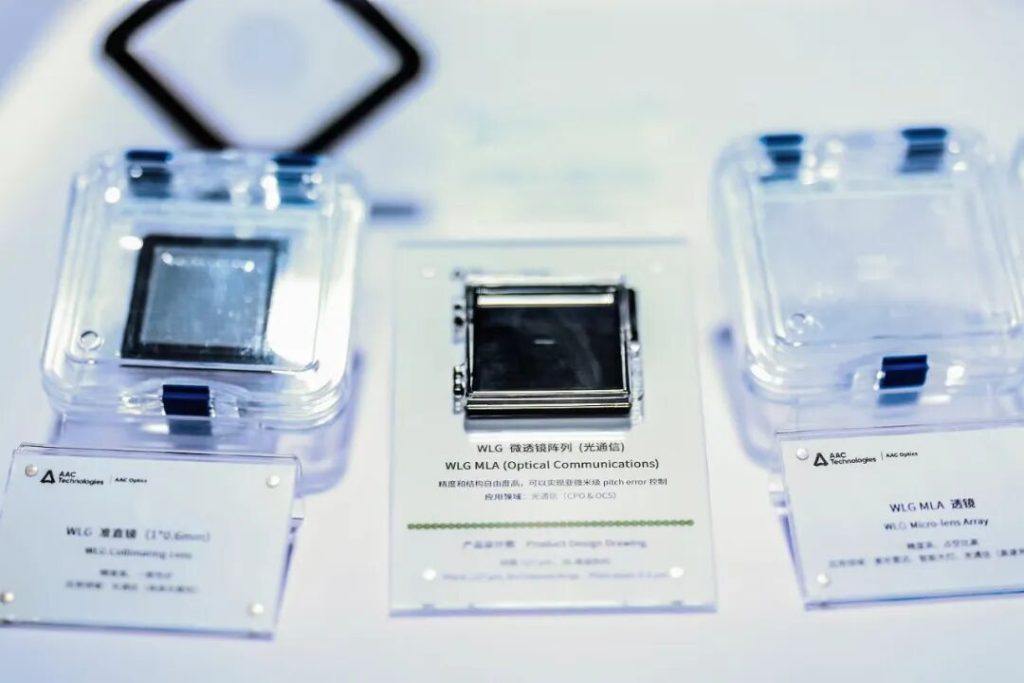
As a core next-generation high-speed optical interconnect technology, Co-packaged Optics (CPO) has emerged as a critical enabler for the iterative upgrading of AI computing centers and cloud-based high-speed interconnect infrastructure, thanks to its inherent advantages of ultra-high bandwidth and low power consumption. On September 9, AAC Technologies debuted its high-precision CPO Microlens Array (MLA) product family built on its proprietary Wafer-level Glass Molding (WLG) technology at the China International Optoelectronic Exposition (CIOE). The launch demonstrates the company’s proven technical expertise and commercialization progress in the high-end optical communication sector, with mass production of the related products scheduled for 2027.
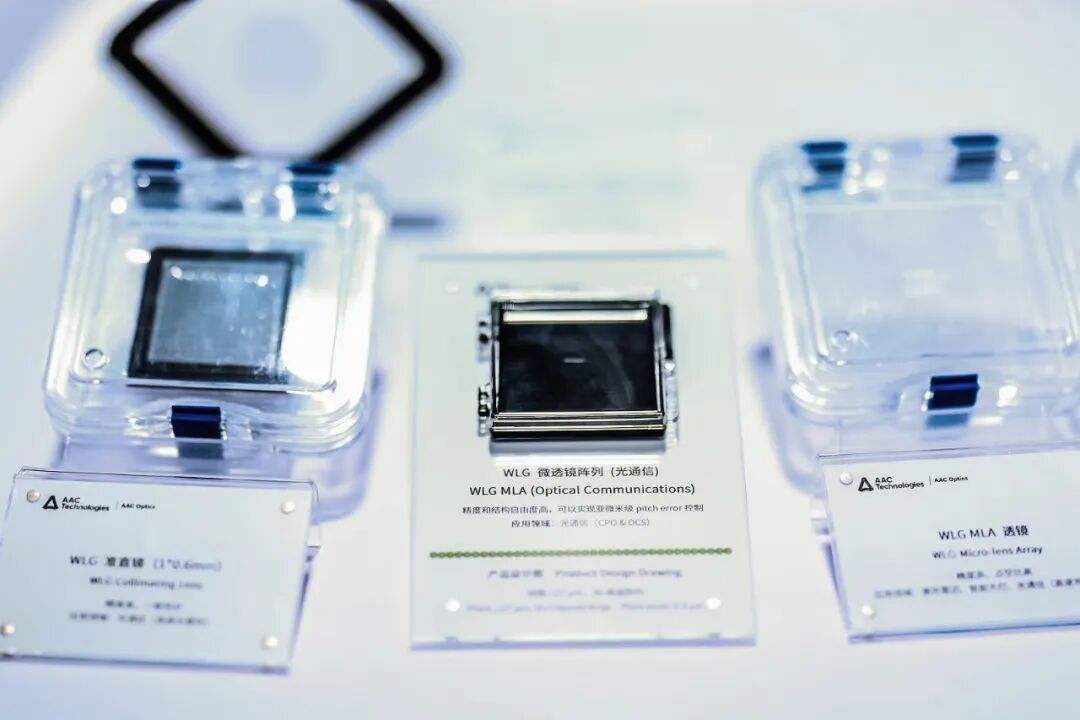
(WLG Microlens Array – Optical Communications)
01Microlens Arrays: The Cornerstone of High-Density Optical Path Coupling for CPO
CPO technology co-packages optical engines and switch chips on a common substrate, drastically shortening opto-electronic interconnection paths and effectively breaking through the bandwidth and power consumption bottlenecks of conventional pluggable optical modules. Compared with legacy solutions, CPO optical engines integrate dozens to hundreds of parallel optical channels, imposing extremely stringent requirements on optical path alignment accuracy and beam coupling stability.Traditional optical communication architectures rely on individual discrete collimating lenses for single-channel beam correction, requiring piece-by-piece mounting and per-channel active alignment. This cumbersome workflow delivers poor batch consistency and cannot scale to meet CPO’s demand for high density and deep integration.
During the optical interface between Fiber Array Units (FAU) and Photonic Integrated Circuits (PIC), inherent mode size mismatch between optical waveguides and optical fibers—compounded by natural beam divergence—causes significant coupling loss that directly degrades the transmission efficiency and long-term reliability of high-speed optical links. As an integrated monolithic optical component, the Microlens Array (MLA) performs simultaneous focusing, collimation, and beam expansion coupling across multiple divergent beams. It fully replaces conventional discrete collimator solutions, resolving both multi-channel beam shaping and mode field matching in a single step, making it a critical core component for efficient high-density optical path coupling in CPO systems.
02WLG Process Establishes Technical Barriers for CPO-Grade Microlens Arrays
Unlike conventional optical components, MLAs designed for CPO require synchronized multi-channel beam shaping, mode field matching, and sub-micron positioning accuracy. This imposes technical specifications far exceeding those of traditional optical modules across material performance, processing precision, array uniformity, and environmental stability. For core substrate selection, glass has become the undisputed preferred material for CPO MLAs due to its superior comprehensive optical properties.
For the industry-standard O-band (1310 nm) and C-band (1550 nm) operating bands, glass exhibits extremely low absorption and scattering losses, exceptional optical homogeneity, and non-hygroscopic characteristics, maintaining stable optical performance even under harsh humid and high-temperature operating conditions. It is also fully compatible with high-temperature reflow soldering assembly processes, with outstanding heat resistance and long-term aging durability. Furthermore, glass has a Coefficient of Thermal Expansion (CTE) highly matched to silicon-based PICs and optical fibers, preserving precise optical alignment across wide temperature ranges and fully satisfying CPO devices’ requirements for long service life and high reliability.
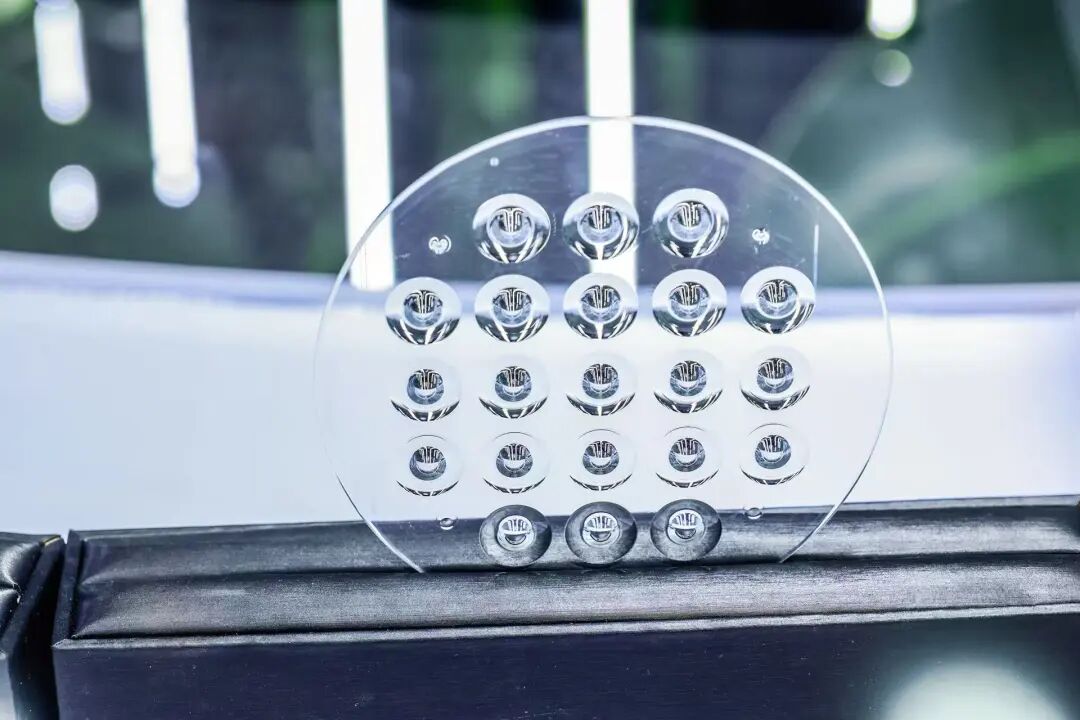
( WLG 4-inch Wafer – Aspheric Lens)
Superior material properties require equally advanced precision manufacturing to unlock their potential. AAC’s self-developed WLG wafer-level glass molding technology delivers an end-to-end process chain from high-precision mold fabrication to wafer-level mass replication, directly addressing the industry’s longstanding pain point: scaling high-precision glass array components to volume production.
Its core competitive advantages lie in two pillars:
- Ultra-high-precision mold machining: Enables one-step molding of microstructures including microlens surface profiles, array pitch, and V-groove alignment features, locking in the upper limit of product accuracy at the source.
- High-precision glass molding: Faithfully replicates nanometer-scale features from the mold, enabling high-uniformity, standardized mass production of array components.
03Accelerated Commercialization Roadmap: Mass Production Targeted for 2027
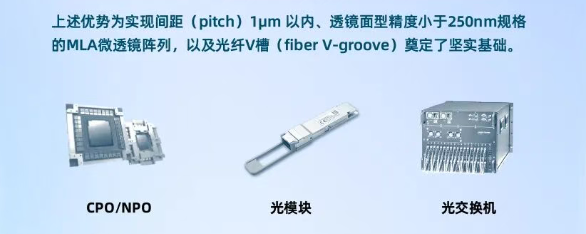
Building on its mature WLG wafer-level glass molding platform, AAC has already achieved MLA development capabilities with pitch accuracy of 0.35–0.5 μm and lens surface profile precision below 200 nm—meeting the high-end qualification threshold for CPO volume production and fully satisfying the tight alignment tolerances of CPO multi-channel array optical paths. Ongoing process iterations are expected to set new industry benchmarks and drive the evolution of the CPO high-speed optical communication ecosystem.
Compared with traditional single-piece lens manufacturing, AAC’s simultaneous multi-cavity molding process on 4-inch wafers produces multiple array components per wafer in a single production cycle. While delivering industry-leading precision and batch-to-batch uniformity, this approach dramatically improves production throughput and scaling capacity. In addition, WLG components are fabricated with integrated high-precision alignment reference features, enabling passive multi-channel simultaneous alignment during downstream CPO optical engine assembly—eliminating the need for slow, expensive per-channel active alignment. This significantly shortens production cycle time, reduces customer capital equipment expenditure and unit costs, and provides a cost-effective, production-ready solution for large-scale CPO commercialization.
Powered by WLG’s three core strengths—material performance, precision, and manufacturing efficiency—the commercialization of AAC’s optical communication business is accelerating steadily. The company is currently engaged in in-depth technical collaboration and joint development with multiple leading global optical communication firms and AI/cloud high-speed interconnect chip vendors. Several customized CPO passive optical components have completed technical alignment and successfully entered customer sample validation. Per the product roadmap, AAC’s first-generation WLG passive optical components for high-speed data centers are on track to enter volume production in the second half of 2027.

The debut of the WLG CPO optical product line at CIOE marks a key milestone in AAC’s deep expansion into high-end optical communications and strategic positioning in the AI high-speed interconnect sector. Going forward, AAC will continue to advance WLG wafer-level glass precision processing technology, iterating on high-precision, high-uniformity, mass-producible core CPO optical components, deepening strategic partnerships with global industry leaders, and powering the next generation of optical interconnect upgrades for AI computing infrastructure.